
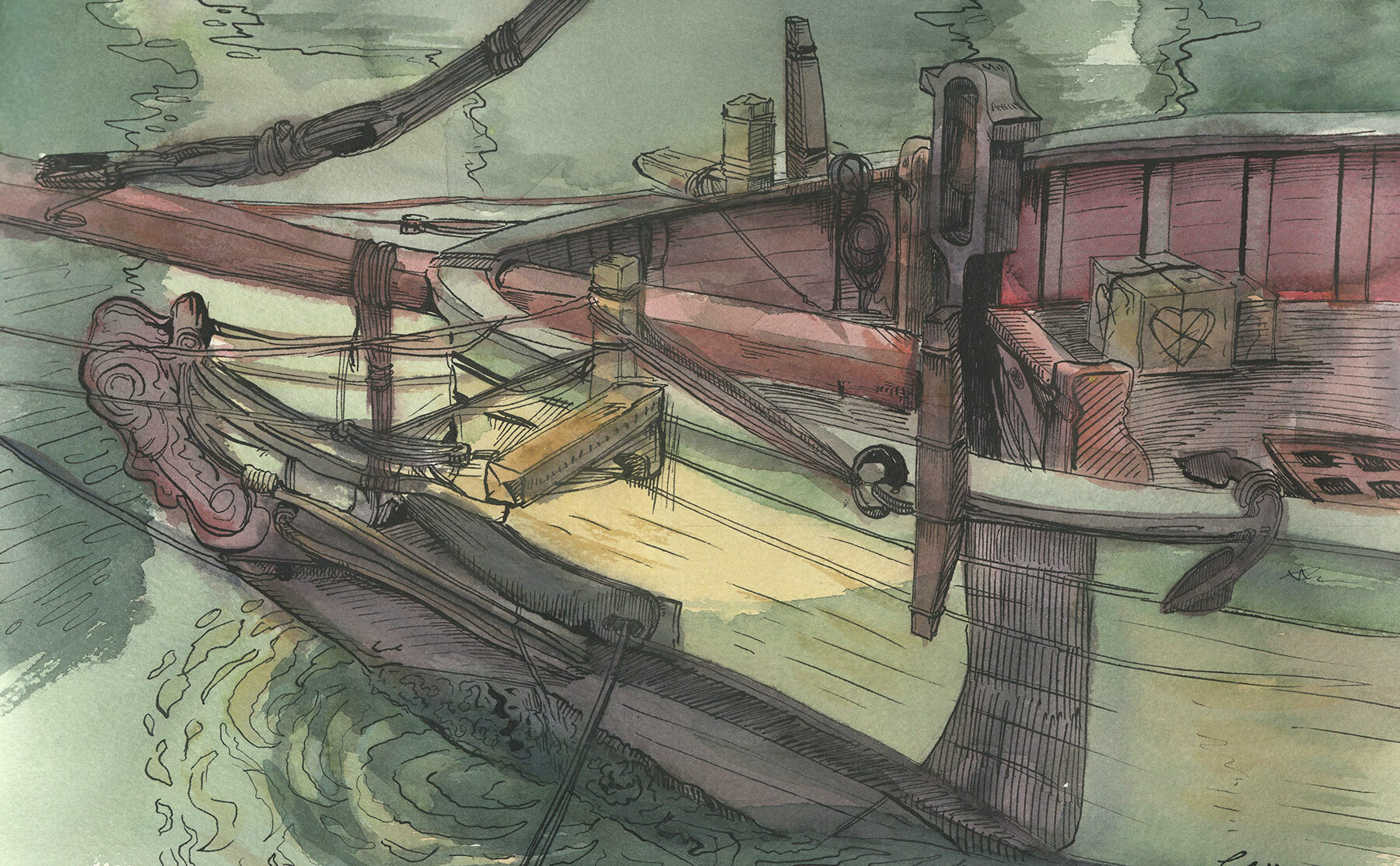
City in Faded Light: Eli Portman Solo Show
Edited by Kyra Scott
Over time, urban environments expand to fit society’s growing needs while carrying fragments of history. According to Eli Portman, these urban areas begin to reflect the health and liveliness of the people living in and around them. In this interview, Olivia Hoagland, the Communications and Development Coordinator at Co|So, asks Portman to delve into his creative practice and discuss what this solo exhibition means to him.
City in Faded Light will be on view until March 14th and Eli Portman will be giving an artist talk in the gallery on Sunday March 8th to discuss his practice even further.
Note: This interview has been edited for length and clarity
Hoagland: Thank you for coming today!
Portman: Pleasure!
Hoagland: Thank you so much. I’m really excited to talk about this. You just brought in your artwork that has yet to be seen.
Portman: Yes!
Hoagland: I’m very excited for the public to see it.
Portman: Me as well!
Hoagland: I’m going to start with some questions. Could you give us some background on your career as an artist and the journey of developing your practice?
Portman: Sure! I’ve been doing art for a long time but I studied art more seriously at SUNY Binghamton in upstate New York. I graduated in 2014 and moved back to Boston, which is where I’m originally from. I kind of jumped in head first– I didn’t have much of a plan and I didn’t have a lot of savings, as many artists don’t.
Hoagland: Yeah! *Laughs*
Portman: I was working different jobs and I was trying to make better art. I had a lot to learn! Just by going to school for art, I didn’t have a very strong foundation. I kind of picked up a lot of things along the way, but my art has, in the 10 or 11 years since, grown exponentially beyond that based on less of the technique that I learned and more on just the ethical approach to art making. Always innovating, studying from historic art, not being afraid to try different things– which I actually run into a lot. A lot of the time, I use a technique and I say oh I shouldn’t do that, and then I’ll find a famous artist that did and say oh I should probably do that.
Hoagland: “Oh, I guess I can!” *Laughs*
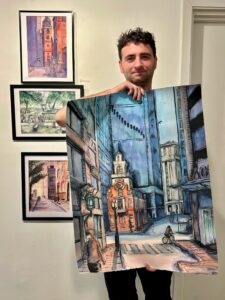
Eli Portman standing in front of 3 of his artworks and holding his painting Old State House.
Portman: If it was good enough for him or her, it’s good enough for me! And being willing to try different things. There’s some things that I straight up haven’t tried that I feel like won’t work at all. But generally, my process involves taking photos, copying the photo, making it a painting one-for-one. Along the way, I started to realize that I could take those photos, and I could do more with composition and I could do more with color, and that’s only been in recent years. I really should probably go and straight up take some more classes, but in lieu of time, I’ve been doing a lot of online research book reading and trying to develop my color and my composition better. I know how to use a brush and I know how to mix paints and I know how to draw, so how do I make that better than the photo? Because sometimes reality doesn’t give you everything you need to make a good piece of art and you need to take it a step further. As I went along and experimented with that, I was able to grow my practice into full-time, and be able to build from where I started. In part because I was selling familiar Boston scenes to locals. Sometimes I was selling unusual scenes to people from out of town that wanted to bring something with them. I was teaching classes which I continue to do, and also trying things that are more experimental. I always wanted to go a little bit deeper and darker with my work but I felt for a long time that my clientele wouldn’t go for that kind of thing, given the fact that I was doing a lot of local scenery. So, I’ve been experimenting with that a little bit on my own. I haven’t really shown that publicly yet, but trying different things and experimenting and growing my skills but being willing to manipulate reality is really what has changed a lot over the years.
Hoagland: What do you mean by darker?
Portman: The world has become seemingly a little depressing. It always has had a depressing angle but I know for me, becoming a post-college adult, a young professional, into where I’m at now, the structural things seem to have shifted and things that we kind of took for granted changed in the world a little bit. So I’ve been making work that comments on that, usually in a way that is less hopeful and more trying to show others that we all have certain things in common to build from.
Hoagland: That’s really beautiful, I’m excited to see that.You’ve been a very active member in the past year by leading artist demonstrations and discussions. Could you tell us more about these experiences and any future plans for the new year?
Portman: With the Copley Society or just in general?
Hoagland: In general, anything!
Portman: I’ve been a member of the Copley Society for a number of years now. I was going to say, I think I started here in maybe 2016. I think it lasted for a year and then I came back, so it’s been a number of years. The thing that I always say is, in terms of planning for the new year, part of the reason that I’ve been so involved in the Copley Society is that I love the bold direction that the new leadership has been taking. It’s always been an amazing place and it’s always been a great communal place to show art in the Boston landscape, but I love all the different ideas. All the things that I’ve seen happening here are very cool and the amazing staff are very innovative trying different things which you have to do because the gallery scene both in Boston and in general is changing a lot. Art is changing, where people get their art is changing, so I love that and I want to be involved as much this year, if I’m able to. That’s one of my big plans. I’ve been making a lot of work specifically for this show, which I don’t always do. Sometimes I have a show and I just grab what I have and put it together. But I’ve been really making stuff with an eye towards this space and what I think will look good here and for the neighborhood.
Hoagland: That’s so exciting!
Portman: Especially since my studio is down the road, I feel like I’m really active in this part of Boston so I’m trying to reach that sort of feeling. I have a show in New York right around the same time– we’re still planning that, so I won’t tell more, but I’m making a lot of stuff for that and that’s my other big plan. After that, it sort of remains to be seen. Some of the projects that I get are planned way in advance and other times someone just says hey can you do this thing?
Hoagland: Absolutely!
Portman: *Laughs* And some of the most interesting ones have happened that way. But beyond that, it’s hard to say.
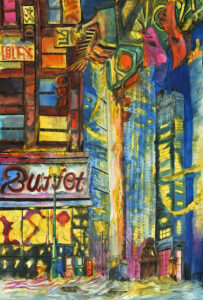
“Blue Twilight in Chinatown”
Eli Portman
pen and ink, ink wash on paper, 22″X30″
Hoagland: Okay, very interesting, that’s very exciting. The next question, very broad, talk a little bit about the ideas behind your body of work. It can be about this show or just the process in general.
Portman: It was always kind of about seeing the urban landscape of Boston and trying to show the way that I see it on the inside. I’ve had friends and relatives say to me, “I love your paintings, especially since you paint such ugly places and make them look so nice!”
Hoagland: *Laughs*
Portman: Because I did a lot, especially in my earlier days of work, I was doing a lot of alleyways behind the buildings, just like those alleyways, *gestures to window* doing interesting things with them.
Hoagland: Places that go unseen.
Portman: Places that go unseen was always the idea but the other idea is that for me, I find cities so interesting. I do a lot of architectural renderings but it’s not really about the architecture, it’s about the way we build the structures around us to impose a sense of stability. And whenever I go to a new city or walk around different neighborhoods in Boston, I’m looking for certain things with my camera, and it’s not just things that look interesting. It’s sort of an idea of how the way that we build and maintain streets, roads, buildings, businesses reflects the health of the city, reflects the population of the city, reflects the way in which we try to pretend that things are a certain way when in the wild they’re not, right? We put sewage in and then we have a septic system and we have running water. We put all these things in to impose a sense of stability in our lives, but really there’s always this underlying insecurity of just being the person on this planet. So for me, analyzing the city scene isn’t just about beautiful sets of color or light, which is part of it, but it’s about how I can navigate or inspect the surface level way that we represent what’s going on underneath. Sometimes it’s just the way the light catches something does look really nice, but I find that especially in a city like Boston that had some rougher days decades ago and now it’s very overpriced and expensive, we have a lot of people wanting to live here. There are new apartment buildings opening up, older buildings are getting torn down as cities often do. There are parts of the city that have great services and other parts that really really struggle. There’s a long history of segregation and gentrification in Boston that is still there despite the fact that Boston kind of acts as if it’s a very modern city. There’s a lot of old issues underneath that have not been resolved that we’ve built on top of. So whenever I go to a new city, I often travel when I’m with my wife and I’ll say, “This is so interesting. I’m trying to figure this city out,” like, “Look at that! All those shops are closed, what’s going on?”
Hoagland: “Why did that happen?”
Portman: Yeah, why did that happen? “But this looks really nice over here”. Recently we went to Portland Maine, which I haven’t spent a lot of time in and part– it’s a really beautiful city– but part of it by the harbor is like the very boujee area and then the other part is kind of the old Portland and you get a very interesting division where you cross the street then suddenly the shops change.
Hoagland: Yeah!
Portman:Right? And suddenly you get very chic-type displays and then you get the Public Library and there’s like the older stuff and the traditional, some old art galleries and museums. So it’s interesting to walk through any new space and think of it that way.
Hoagland: Yeah, that reminds me, I moved here originally from North Carolina last year so I’m still very new to the city but I learned so much through the art that comes in the gallery.
Portman: What people paint and what they don’t.
Hoagland: Yeah, just walking around through the city and finding new buildings and looking up from my phone and seeing all these different angles. That was part of why I invited you, other than your show coming up! It was like you captured these moments, but usually ones that people just walk past.
Portman: Yes, and there’s a lot that I haven’t done. I have the same problem that I run into where I do paint a lot of the same places here. It took a long time to go to other parts of the city, but I encourage your listeners to go to the parts of the city you don’t normally go to and look if you notice anything different.
Hoagland: Like little adventures!
Portman: Yes, that’s what I did. I took my camera a while back and I hopped to the end of the red line. Went all the way to the end, then took the orange on the other way. I took the blue line out to Wonderland and I saw all these interesting things.
Hoagland: I’ve never done that wow.
Portman: Back before they demolished it, at the end of Wonderland was the dog race track. There was a greyhound racing track with a stadium where you can bet on greyhound racing.
Hoagland: Really?
Portman: Then that became illegal not that long ago. And there was horse racing as well– yes there’s still a horse racing track that I think is used mostly for other things because horse racing, I think, is also banned. So if you go to the horse racing track, there’s screens where you can bet on horse races happening in other states. They don’t happen at Suffolk Downs.
Hoagland: Okay, that’s fascinating!
Portman: You see things shift, and now that I’ve been back in Boston post-college for upwards of 10 years, I’ve seen a lot of things close and a lot of things change. Cannabis shops have popped up everywhere!
Hoagland: Right! *Laughs*
Portman: That was just a few years ago, you know! Like I said, certain things were banned, there’s lots of changes. There are parts of Boston that, growing up– I grew up in the burbs– there are areas that I probably wouldn’t have wanted to spend time in that weren’t so safe but are now much different. So it’s interesting to see.
Hoagland: Yeah definitely. We have two more questions.
Portman: Sure!
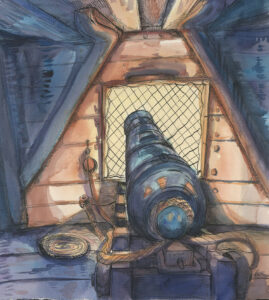
“Cannon on Old Ironsides”
Eli Portman
pen and ink, watercolor on paper, 15″X16.5″
Hoagland: You talked about the ink and watercolor classes that you teach. How are these classes structured, and how do you engage the community in them?
Portman: I offer different types of classes in different places, and I used to offer more things. When I started college, I did oil paintings and I did some oil classes. I don’t think I could do that anymore– it’s been too long. Mostly I offer drawing, watercolor, and ink and watercolor, which are kind of what I do myself and I’m most familiar with. In doing that, the workshops like I offered here are one time sort of things. We bring in an image, we usually work from a reference. I teach the way that I paint, which is essentially I bring an image, we talk about how to render that image, we talk about things like mixing paint, using color, applying paints, where things should change or stay the same. It’s the same kind of thing I talk about in my process. For my ongoing classes that I teach in other places, it’s a little more structured on how we can build skills every week. So we start with very very basic putting paint or ink on paper, and we work our way up to things like more complex imagery, basic composition, rule of thirds, trying to rearrange certain things– some things that I’m sort of grappling with to make a painting better than a photo.
Hoagland: Sounds like you kind of take away those initial nerves of just starting.
Portman: A lot of people come to me, especially since I used to offer more classes to the youth, and especially during COVID. These days because my schedule is different, I mostly offer classes during the day and I get a lot of retirees. Not entirely, but often people who have left art for a long time and want to return to it or have never tried before and always wanted to. That can be intimidating, just trying it for the first time! Part of taking the class is just saying, “Look, you’re here to do it, it’s ok to fail.” Especially with watercolors and drawing, you’re gonna have some failures.
Hoagland: Right, yeah.
Portman: I have many and I have some work in the show that I’m not proud of, and that’s okay. A big challenge that I help students face is just taking that first step– not into learning technical drawing on its own, but learning about making mistakes. We spend a lot of time in our lives trying not to make mistakes, and then say, “No, it’s okay. Your drawing is going to come out and be bad, and it has to come out bad before it can come out good.”
Hoagland: “That’s a good lesson.”
Portman: That’s one of the biggest lessons I learned in schooling. You’re gonna have some teachers telling you that you did a bad job and you have to rise from it.
Hoagland: You’ve gotta take it.
Portman: That’s really hard, but that’s the classic way of hard teaching. You know, “You didn’t do it, so do it again.” But you could do it again!
Hoagland: You can do it again, that’s the beautiful thing!
Portman: There’s always a second chance if you want there to be.
Hoagland: My last question is, what do you want people to take away from your show City in Faded Light.
Portman: A lot of the things that we talked about. These same ideas of how we can look at our city differently, especially if we want our city to change for the better. How we can pay more attention to it and pay more attention to the health of cities like Boston. There are always things to be improved upon, for sure.
Hoagland: It’s such a great city, it’s why I moved here.
Portman: I love this city. I love when people come here and are new to it. It’s very exciting, and the more time you spend here the more it becomes a relationship of loving it for its flaws but also wanting those flaws to change. Especially when you’re newer, it’s all these things to learn. For one of my side jobs that I worked over the years, I was a bicycle delivery boy.
Hoagland: That’s so cool!
Portman: I was making art in the morning and delivering in the afternoon. While I was doing that– this was before E-bikes were really as much of a thing, so it was all pedal– and I peddled on every street in the downtown area.
Hoagland: You learned it like the back of your hand!
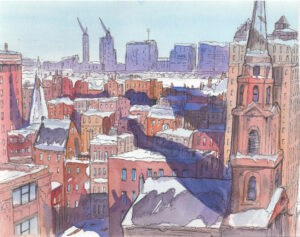
“Back Bay Rooftops in Snow”
Eli Portman
pen and ink, watercolor on paper, 9.5″X15″
Portman: I really know the city, I know the streets, I know a lot of it. They say cab drivers before GPS, they would just know everything and it would be part of their brain. You start to pay attention to different things when you know the city so well, not to say that you don’t know it already in a way, but there’s a lot to learn.
Hoagland: I’m still learning everyday.
Portman: Once you’ve learned it all, you start looking at it again in a different way and then you start to think about why. This street is great, why is it great? Why is that street different? They’re next to each other! Why is this one like this and that one’s like that? There’s a reason! Sometimes the reason is chaos, or someone just didn’t plan something right.
Hoagland: Old carriage rides!
Portman: Why does the green line go through tunnels here and not there? Well, it’s because when they were going through the tunnel there, they found all these buried bodies. They had to pull them up and move them around, and that’s why the cemetery is there. They did this, and then people were afraid to go underground because that’s the devil’s domain if you go underground.
Hoagland: Wow!
Portman: It’s the early 1900s, all these weird things that are part of the fabric of our city.
Hoagland: It’s fascinating, it really is fascinating. This is such a great conversation, I’ve learned so much!
Portman: It’s one of my favorite topics! I have lots to say about Boston, and there’s many artists that have painted Boston, both in Boston and traveling around in the New England area. I wish there was a catalog for all of the Boston art because there’s so much
Hoagland: That would be really cool because everyone’s perspective is different. They capture different moments and everyone’s styles are different.
Portman: I wish there was a better way to examine Boston’s art history through some kind of book or something because I feel like there’s a lot we would see and a lot we would pay attention to. Right now, there’s the Crite exhibit over at the Gardner Museum and at the Athenaeum and that’s another example of a Boston artist who painted things as they were changing.
Hoagland: It’s a beautiful exhibition.
Portman: Really really interesting yeah, and I was aware of his work but I didn’t know the extent. Especially since– I haven’t seen the Athenaeum show yet but at the Gardner, a lot of them are ink and watercolor, which I did not realize because I mostly know him for his oil painting.
Hoagland: I also did not realize.
Portman: He apparently didn’t do all oil painting. That was early on and then he went more into the stuff that was easy to reproduce and I was kind of blown away. So, very interesting!
Hoagland: I work there as well. I work in the gift shop, so I get to see a lot of fun things and the merchandising for what goes into a show like that. Giving the people what they want, what it is they want to see, and what they get to take home with them.
Portman: Yes!
Hoagland: They get to take home all this new information about the city that they live in or they’re visiting. It’s great that now with all these great exhibitions going on here, you’re also now going to have one. You’ve had many, but this one is very exciting.
Portman: It’s very exciting, this one is a little different. I’ve been in many shows and I’ve been in many group shows, but I’ve wanted to do something in a space like this for a long time. It’s thanks to your team that it’s been made possible. I don’t think this would have happened in this way until now, so I’m very excited.
Hoagland: Yes, it’s very exciting! Thank you for talking with me today, this was very lovely.
Portman: It was a real treat!
Hoagland: I’ve learned so much it was really great.
Portman: Sure!
See Eli Portman’s solo show, City in Faded Light, in the Lower Alcove Gallery until March 14, and select pieces in Small Works: Embark until April 25th.
Note: The Allan Rohan Crite exhibition mentioned has since closed, but Crite’s work is still available to view in the Athenaeum’s permanent collection. Crite exhibited at the Copley Society in 1989 as a featured artist in “Contemporary Boston Afro-American Artists,” also showcasing the work of Robert Freeman, Paul Goodnight, and Lois Mailou Jones.