
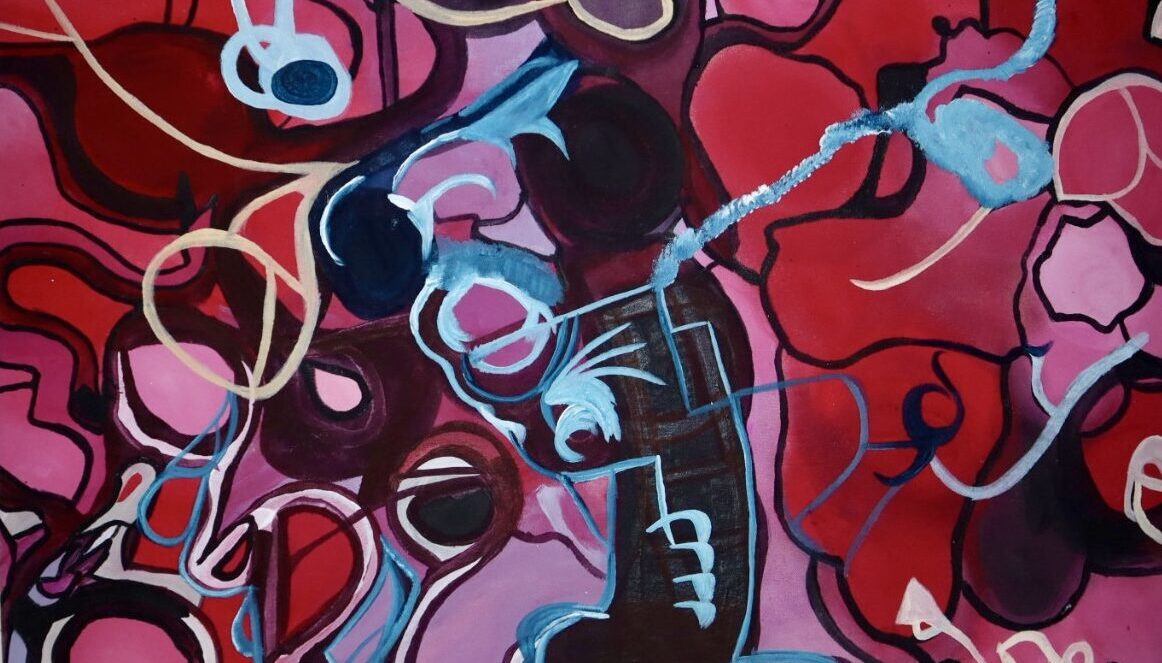
Featured Image: Bluessence by Daniela Solis
Co-written by Olivia Hoagland and Kylee Sheehan
In collaboration with the Harvard Club of Boston, The Copley Society of Art (Co|So) invited its Emerging Artist Members and Guest Artists to submit their work for a curated exhibition celebrating the developing careers of visual artists. Curated by Lauren O’Neal and organized by Carolyn Longden, this exhibition highlights the innovative and diverse practices of rising artistic voices.
Scheduled for June through October 2026 on the third floor at the Harvard Club of Boston, this collaboration brought together two longstanding Boston institutions. Co|So, founded in 1879, continues to support working artists and their evolving practices, while the Harvard Club, founded in 1908, has remained a place for conversation, ideas, and cultural exchange. This collaboration is a chance to build a more direct relationship between these communities through art.
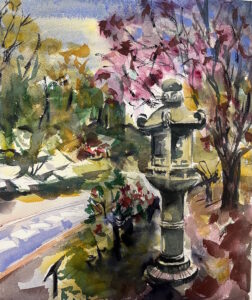
‘Morning Light At The Japanese Garden’ by Barbara Marder
Lauren O’Neal is a curator, interdisciplinary artist, and educator. O’Neal is currently Associate Professor of the Practice at Boston University and previously served as director and curator of the Lamont Gallery at Phillips Exeter Academy. She is also a research affiliate at the Uniarts (Finland) Research Institute, and a board member of the Journal for Artistic Research and the Brickbottom Artists Association. O’Neal holds a doctorate from the University of the Arts Helsinki, an MFA from Maine College of Art and Design, and EdM from Harvard University, where she returned to pursue a visiting fellowship at the Harvard Graduate School of Arts and Sciences.
OH: When in your career did you develop your “voice”?
LO: I’ve developed my voice throughout my career, it’s a process that never really stops. Each new project, exhibition, or collaboration has taught me something new and vital. It’s easy to spend a lot of time thinking about what direction to go, but ultimately, it’s the doing, creating, testing, exploring, and engaging with different people and places. That’s what has helped me learn to trust my own knowledge.
OH: During the jury process, how did the interpretation of Emerging Voices come together? Were there different iterations before the final lineup?
LO: What shaped the jury process was a focus on inclusion. “Emerging” doesn’t just apply to artists at the start of their career, it also applies to artists at different points in their artistic journeys or artists who are exploring new materials and approaches. I was initially overly ambitious and wanted to include several pieces from each artist, but we scaled back to fit the work within the available space at the Harvard Club. I’m so pleased that bringing the works together has created a dynamic visual conversation!
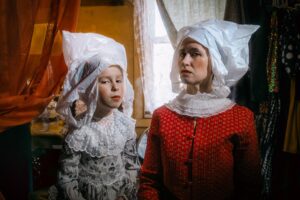
‘Part-time Dutchesses’ by Mari Saxon
OH: From a curator’s perspective, what makes a piece belong in a show?
LO: What a wonderful and complex question. For me, there’s no “universal” choice about what belongs or not. It depends on the mission of the exhibition. More broadly, I look for how submissions illuminate an exhibition theme in compelling ways, interesting approaches to materials, compositions, or content, and alliances between the works. Sometimes decisions are practical. For example there might be too many submissions, or limitations on the mediums that can be displayed in the gallery. The context of the venue and the hosting organization(s) are also important factors.
OH: What arose from the exhibition after seeing the artworks on the wall? And or, how did the exhibition develop after viewing the works in person versus viewing online?
LO: One of my favorite aspects of exhibition-making is when the work arrives. It’s truly magical to see work in person that you’ve only previously seen digitally. Placing the works is equally rewarding. Sometimes this process takes a lot of time, but in this case, the placement came together quickly with help from Paige, Nina, and the Harvard Club team.
OH: What do you recommend for emerging artists in finding their voice?
LO: Say yes to everything (or many things!) at the start. You may think you know what you like or what opportunity will be suitable, but you really don’t know until you try. Don’t let other people’s assumptions about who you are restrict your options. Keep applying. Rejection is not about you. Let it go and move on. Create your own opportunities. There are excellent venues in Greater Boston that welcome curatorial proposals, such as the Brickbottom Gallery and Gallery 263. Even many libraries and restaurants have exhibition programs. Participate in multiple communities, this is especially critical after you’ve left school. Join collectives. Volunteer. Attend events and talk about what you’ve seen with your friends. Keep learning, formally and informally. Continue to make. Don’t wait for inspiration. Just do the work. Be kind as often as possible.

‘Taste of Maine’ by Mena Levit
Carolyn Longden, is based in Boston, MA and currently the Director of Member Events at Harvard Club of Boston. Carolyn Longden brings experience from previous roles at SoWa Power Station, Longwood Venues & Destinations and Chevy Chase Club. Carolyn Longden holds a 2003 – 2007 BS in Hospitality and Business Management at University of Delaware. With a robust skill set that includes Banquets, Hospitality, Event Planning, Hospitality Management, Food & Beverage and more.
OH: How has collaboration with artists assisted the growth and community in Harvard Club?
CL: At the Harvard Club of Boston, our mission is to create meaningful opportunities for members to gather, connect, and build lasting relationships; not only within our membership but also throughout the greater Boston and Cambridge communities. Collaborating with artists has been an important part of achieving that mission. By partnering with artists from both within and beyond our membership, we’ve created experiences that inspire curiosity, creativity, and conversation. Our arts programming has included hands-on classes with Co|So artist and instructor Eli Portman, Art Showcase Receptions in collaboration with the Harvard Office for the Arts and the Copley Society of Art, as well as rotating exhibitions displayed throughout the Clubhouse. These initiatives transform the Club into more than a gathering place, they create an environment where members can engage with art, discover new perspectives, and connect over shared interests. Our partnership with Co|So has been particularly meaningful because many individuals are members of both organizations. That crossover has strengthened our relationship, generated excitement around joint programming, and introduced members of each community to the other. These collaborations have broadened our audience, fostered new relationships, and reinforced the Harvard Club as a welcoming cultural hub where art serves as a catalyst for community, collaboration, and lifelong learning.
OH: How do you maintain a balance between celebrating tradition and welcoming new
ideas?
CL: The Harvard Club of Boston was established in 1908, and I joined the team in 2023. Stepping into an institution with such a rich history meant I first had to understand what our members valued most and why certain traditions had endured for generations. I quickly learned that many Harvard and Club traditions are deeply meaningful to our members, so we make a point of incorporating them into our programming and celebrating them in ways that honor the Club’s legacy. At the same time, I also recognized that some experiences that had once been very successful were no longer resonating with today’s membership. Rather than holding onto them simply because they had always existed, we viewed that as an opportunity to either thoughtfully reimagine those events or make room for new ideas that better reflected the interests of our evolving community. The key to maintaining that balance has been listening to our members. By combining membership data with direct feedback, we’ve been able to develop programming that respects the traditions that define the Harvard Club while introducing fresh experiences that appeal to current and future generations. My goal is always to preserve what makes the Club special while ensuring it continues to evolve. In doing so, I hope some of the new experiences we create today will become the traditions our members cherish tomorrow.
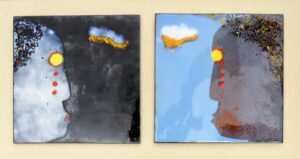
‘America – 2025’ by Alan Kaplan
OH: How have you seen art and history propel individuals towards their future?
CL: Art and history allows us to understand where we’ve been, challenge us to think differently about the present, and inspire us to imagine what is possible in the future. The experiences we host at the Club that bring members face-to-face with historians, authors, artists, architects, designers, and creators, has allowed me to witness people leave events not only with new knowledge, but with a renewed sense of curiosity and purpose. I’ve also found that these events create lasting human connections. People often arrive expecting to learn something new, but they leave having built relationships, discovered shared interests, or found inspiration that influences their next professional or personal step.
OH: In your experience, how has displaying artwork created a community?
CL: Displaying artwork creates community by giving people a shared point of connection. I’ve planned events both at the Club and excursions for the membership where art is an important part of the environment, and I’ve seen how it naturally encourages conversation between people who may not have otherwise met. A painting or historical artifact often becomes the starting point for discussions that evolve into meaningful conversations. Artwork also has a unique ability to bring together people from different backgrounds and generations. Each person interprets a piece through their own experiences, and those differing perspectives create opportunities for dialogue, learning, and empathy. I’ve watched members who arrived as strangers spend an evening discussing a work of art, sharing stories, and leaving with new friendships or professional connections.
OH: How has the culture of the membership evolved over time?
CL: Although I’ve only been with the Harvard Club of Boston since 2023, one of my first priorities was understanding the culture and history of the Club. Through conversations with longtime members, learning the Club’s history, and observing our programming, I’ve come to appreciate how the membership has evolved over time. Historically, alumni clubs were primarily places for graduates to maintain their connection to Harvard and network with fellow alumni. While those goals remain important, today’s members are looking for something broader. They want opportunities for lifelong learning, meaningful experiences, cultural engagement, professional development, and community. Members still value the traditions and prestige of the Club, but they also want programming that reflects the interests and diversity of a modern membership. To me, the Harvard Club continues to honor its legacy while creating new opportunities for members to connect with one another and with the broader Boston and Cambridge communities. That balance is what keeps the Club vibrant and ensures it remains valuable for future generations of alumni.
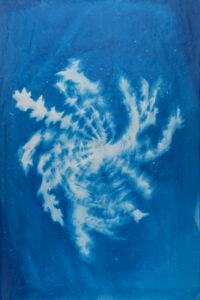
‘Spear Thistle Spiral’ by Suzi Grossman
The attention to detail from Carolyn Longden, The Harvard Club staff, the Co|So Team, and Lauren O’Neal has resulted in a spectacular arrangement of artistic talent. The artwork included in the Emerging Voices exhibition is on view for Harvard Club members until October 5th as well as available to view or purchase on our website.