

Alongside Co|So’s show, Small Works: Looking Up, is the Academy of Realist Art’s exhibition. The show presents standout student works that are representative of the rigorous academic training required to earn a Certificate of Completion, alongside dynamic personal works by ARA Boston instructors, alumni, and current students. Bringing this group of artists together at Co|So has shown the skill and craftsmanship it takes to create these works. The collaboration and support from artists and community members has been joyous and inspiring.
The opening reception for the exhibition was one of the most well attended in recent years. This relationship is a testament to the importance of kinship and identity amongst artists and how collaboration fosters community; the mission that drives Co|So.
Please view The Academy of Realist Art at Co|So while it is on view until June 6, 2026. Continue reading to learn about a few artists from the show. Specifically, how their artistic process has grown while working with the ARA and what their next steps are.
Artists featured in this blog:
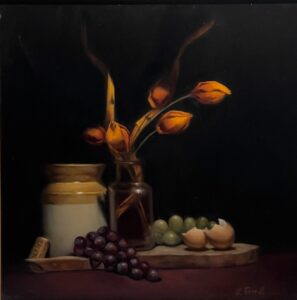
Anaranjada
Lauren Farrell (LF)
Oil on panel, 19.75″ x 19.75″
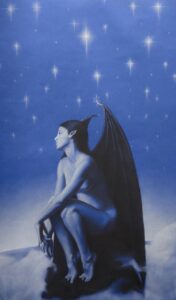
The Confession
Cara Blue (CB)
Chalk and carbon, 13″ x 23″
Question One: What is the title if your piece in the Academy of Realist Art at Co|So show and what was the idea / inspiration behind it?
LF: The title is Anaranjada, the Spanish word for orange (feminine voice). I heard the word and thought it sounded so lovely. The orange flowers in the piece are a focal point and in my opinion, the most successful area of the piece, really demonstrating the power of tenebrism.
CB: My piece is titled “The Confession”. The idea pieced itself together from a few different sources, but it is largely inspired from my experience finding clarity in nature and a desire to bring fantasy to life. I have always loved to watch the moon at night, and it always feels like a sort of therapy session, so I decided to name this piece accordingly.
Question Two: How did your journey as an artist begin?
LF: I’ve always had a love of the arts and anything creative and had some creative hobby or another. I had a career in accounting and finance but I’ve taken painting and drawing and classes over the years, but it wasn’t until I found ARA that I thought I could actually create work as an “artist”. So really my journey began with ARA, though it took me a lot of wrong turns to get there. The program’s well defined curriculum, practical instruction and individual critiques really allowed me to develop my artistic skills at a self-directed pace.
CB: I’ve been interested in realism for as long as I can remember. As a high school student, I took AP art classes and weekly classical drawing lessons after school. After deciding to search for an atelier, I found the ARA and moved from North Carolina to Boston to attend. I’ve now been at the ARA for 3 years.
Question Three: What was your favorite part of creating this piece or your favorite step in your creative process?
LF: The piece was an exercise in tenebrism, something I’d never specifically thought about before ARA, so the whole idea of focusing on dramatic darks and lights emerging from the dark was very exciting. It was so fun to see the focal point of the painting – the vase with the orange flowers and reeds – develop. I loved creating the light effect and the look of glass from strokes of paint on a panel.
CB: I really enjoy figurative work, and my favorite part is when the form starts to turn and transition, and it feels alive. In this piece, it was a lot of fun to figure out how to connect that reference drawn subject with a fantastical atmosphere.
Question Four: How has your artistic style evolved since being academically trained at the ARA?
LF: I don’t think I had a style before being trained at ARA, and I’m still not sure I’ve fully developed a style to describe. I’ll admit to a twinge of envy when I look at other students who seem to have developed a very defined point of view. I think I’m still exploring. It does appear that I tend towards monochromatic or complementary color schemes. And I love realism of course.
CB: ARA training has given me a technical understanding of how to draw and paint realism. Principles of breaking down form and value, and many other learned things, allow me to actually execute the pieces I think up.
Question Five: Please describe the feeling of walking in and seeing your art amongst other ARA artists.
LF: Awesome! It’s an incredible privilege to see my art amongst other ARA artists and it fills me with happiness and pride. ARA has an incredible amount of talent under its roof. It’s so inspiring to see the other artists work. And the community is just so supportive. Time at ARA is always the highlight of my week.
CB: It felt so special to see everyone’s pieces together on the walls of the Co|So Gallery. It was gratifying to see everyone’s hard work celebrated, whether it be an academic assignment or a personal piece that stemmed from technical knowledge. Thank you to the Copley Society for showcasing our work!
Question Six: What other projects are you working on or what are your next steps after this show?
LF: My first priority is to finish my last two assignments, my graduation piece and my self-portrait. Both of which are taking much longer than I’d hoped but they’re the culmination of the program and deserve the effort! I also want to focus more on personal projects so that I can continue to build on what I learned at ARA and see if I can develop that personal style!
CB: I am looking forward to soon entering the final section of the ARA program, growing as an instructor, and developing more pieces in my portfolio. I am currently working on another figurative piece that meshes with fantasy. Prints of “The Confession” and other works will be available in the near future on Instagram @caramae.art.
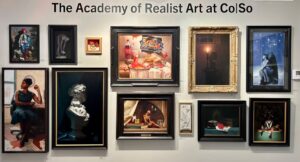
View the online exhibition here and learn more about the Academy of Realist Art here.
Want to support this blog and the people behind it? Visit our support page to learn more about how you can join the Co|So community!