
Juried Minds: Discussion with Payal Thiffault and Michelle May of JUNIPER RAG
Edited by Kyra Scott
To celebrate Co|So’s Juried Member Show: The Measure of Light, Olivia Hoagland sat down to interview with JUNIPER RAG’S founders: Payal Thiffault and Michelle May. This impactful curatorial consulting agency strives to build community around art culture and connection.
The online exhibition is available to view here and the show will be on view until April 11th, 2026. Continue reading to gain insight on how The Measure of Light was juried.
Olivia Hoagland: The Measure of Light explores both the measurable and lived qualities of light. How did this theme resonate in the works you saw while jurying this exhibition?
Juniper Rag: We experienced The Measure of Light with an opened mind, ready to see where the artists took the challenge. We were looking for the measurable qualities of light we know: contrast, shadow, saturation, refraction, to see the technical skills from the artists. We were moved by how artists translated light as lived experience: as memory, as resilience, as rupture, in quiet moments. We saw light used not just to illuminate form, but to articulate messages of hope and resilience in the work. Considering the state of the world right now, we found it especially important to amplify the art that had those messages.
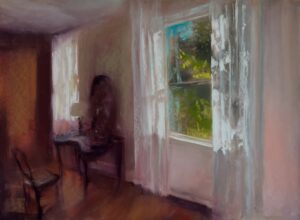
A Safe Place by Cindy Crimmin
pastel, 19″x25″
$3,500.00
OH: What came to mind and what stood out to you as you were jurying this exhibition and choosing the awards? What were you looking for from the artist?
JR: We typically look at the artwork separately then come together and talk about what we’ve seen and what’s interesting is that we almost always have the exact same choices, we just telepathically connect. This time, there were some things that one of us saw that the other one didn’t see, so it was hard to narrow it down.
We’re really looking for the artwork that moves beyond what is expected. Not just shadow, contrast, or luminosity, but the use of light as metaphor, disruption, awakening, cultural signals or novel ideas. We also find that emotions draw the public to a piece, so we instinctively look for work that has a qualified impact on our first round, like all of our prize winners and honorable mentions. We’re looking for artists who are able to translate technical mastery of light into their own emotional, psychological, or even political resonance to grab the viewer and hold them.
All the pieces must be chosen on impact, merit, skill, use of light in any form and we champion the unexpected, the risk takers and moments of whimsy and quietly powerful examples of undeniable value in a piece. In the end, we position the work in a larger conversation with light as clarity, hope, and exposure in uncertain times.
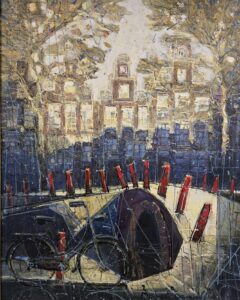
Amsterdam Lights by Michael Ouzikov
acrylic on canvas, 32″x40″
$3,000.00
OH: Your website mentions that “art is not decoration”, but a tool for belonging and culture. How do you help artists translate their deeply personal/ intentional pieces into something that can “work” in corporate lobbies or other high-end spaces without losing its soul?
JR: Artists should never dilute their work, but they should always assess how the public sees their work to understand how to sell it or exhibit it in a way that brings clarity. “Art is not decoration” is a refusal to reduce creative work to passive beauty or surface appeal. Within the curatorial ethos of Juniper Rag, art is understood as an active force and one that challenges, questions and carries meaning beyond pure aesthetic. While decoration completes a space, art disrupts it, inviting critical engagement and emotional response.
For our DWELL exhibition, we worked with interior specialist Jess Klay as our guest juror, and she came up with the phrase “art is not a decoration. We feel that to call something “decorative” has often been a way to diminish it. Juniper Rag resists this by asserting that all artistic forms carry intellectual and cultural weight. Art is not decoration because it cannot be neutral, it is embedded with perspective, emotion and intention, and should be engaged this way.
Original artwork is a window into our collective culture, and that’s what is needed to bring the story into the space. Art holds our narratives, tensions, memories, and intentions. It’s not just ornamental, but made with intent by human hands for a reason to be shared, in private and corporate collections, as public art and community building tools.
Something else we think about is the community, and highlighting local artists. So whatever the business might be or the space might be, we do attempt to get that collaboration going where they join hands with the community and the artist. We help artists articulate that drive behind their work, particularly the emotional architecture, the cultural relevance, the human stakes. We like to share what we see and why we think the art we show is important. When that is clearly expressed, collectors and institutions can meet the work with a deeper connection rather than just aesthetic preference. These stories are magical and help us put art into the hands of collectors.
OH: Through founding Juniper Rag, how has your relationship with art evolved?
JR: When Juniper Rag began, we were mostly interested in celebrating all of these artists that we knew. We grew up on opposite sides of the world and are frequent travelers, so we were focused on building a community and a platform to give opportunity to artists outside traditional pathways. If you show an artist from Worcester Mass with an artist from Paris in the same show, it automatically elevates both of them and completely changes the perception.
Over time, and with 10-12 exhibitions and collaborations per year since our founding, our relationship with art has deepened from amplification to stewardship as we uncover what we know ourselves as artists. We all make art not just because we are creative thinkers, but to share the products of our existence really. What started as advocacy has evolved into cultural architecture that intentionally places work where it shapes belonging, leadership, and lived experience. Our collaborators over the years also benefit from harnessing marketing power and our audience of art lovers and artists. Our aim is to teach artists how to build a network and use every opportunity to the fullest extent.

Image from JUNIPER RAG’s website, art by Susan Auriemma
OH: Light brings new possibilities, clarity, and hope. How has the process of curating this show changed the way you both looked at your own creative and professional experiences?
JR: Curating this show reminds us that light is not always something you wait for, it’s something you learn to “see” and to create yourself if you have to. We saw how successful work can arrive through accident, tension, patience and disciplined attention to details.
Jurying a show is very difficult and we always have to consider each artist, their journey and their story when looking at each singular piece. You have to learn how to look at everything with a clear slate and not compare them to each other. You really want to look at each one individually on the merit of what it is and what it could be, and then think about how other people might view the piece and what it would mean to them. There is a sweetness to uncovering what the artist’s intentions are and measuring that against how artwork makes us feel, its merits and skill as well as how it fits into the exhibition as a whole, or doesn’t and how to make it fit because it deserves to be seen.
It’s always such an honor to view people’s work. Whether it’s with Copley or Juniper Rag, the fact that people trust us with their artwork is really something special. We do feel really energized after every curatorial opportunity, being as we are both creators of art as well.
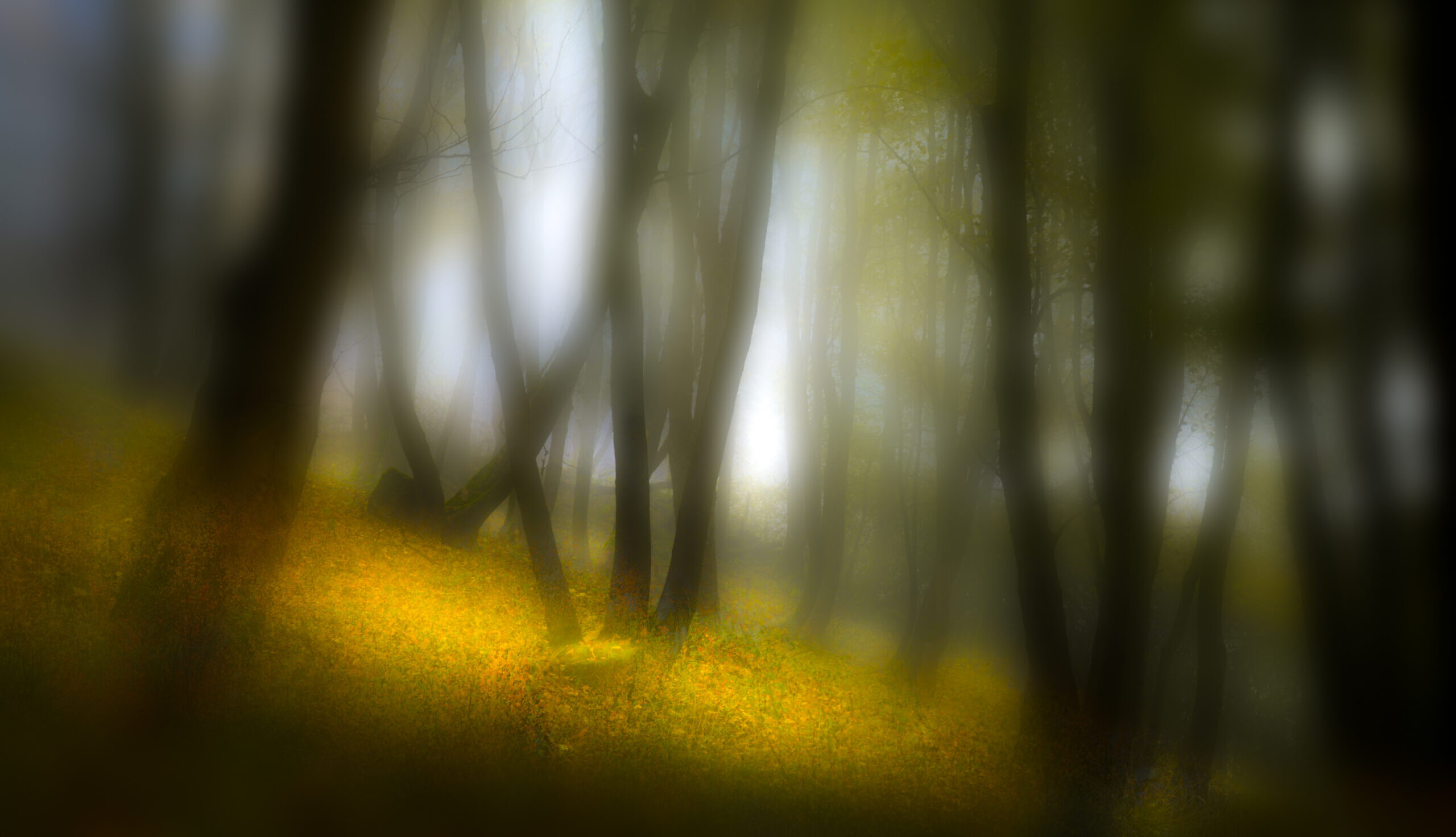
Barely Revealed by Gordon Saperia
archival pigment print, 25″ x 22″
$800.00
OH: What advice do you have for new members of the art community whether its artists, curators or someone outside of the field entirely?
JR: Art can bring so many gifts to those who practice making it. While some may want to sell their artwork, we have to work very hard to find our audience, our people who will appreciate the art we are making. Every market is different and you may not be living in the correct market for your art , so it’s important to do some research, especially when you have super niche artwork. We work with many artists that are here in the central Massachusetts area and show here in Boston, but New York or LA would be their major markets.
Take a chance to really find where your story will resonate the most, in another city or with virtual opportunities like Juniper Rag creating new pathways. Don’t wait for opportunities to come to you, research and act. Find the galleries and the markets that share the same kinds of art that you make. Apply to a lot of opportunities, and if you’ve shown a lot around town in the same galleries, start showing in other places to get out of your comfort zone.
Invest in the creative community around you, show up to openings, help out, and make connections. Once people get to know you and connect with you personally, then they learn more about your art and that’s where meaningful professional connections are made.
Thank you for reading this interview with Payal Thiffault and Michelle May. Co|So’s Juried Member Show: The Measure of Light will be on view in the gallery from March 12 – April 11, 2026. You can read more about Payal Thiffault & Michelle May here as well as visit JUNIPER RAG’s website here.