
Residency Reflection with Kat O’Connor
Interviewed and edited by Olivia Hoagland
Trigger warning: discussion of sensitive topics such as aging and death.
Introduction
With the Fine Arts Work Center (FAWC) residency application now open for Co|So artist members, Communications & Development Coordinator, Olivia Hoagland, sat down to interview the previous recipient of the residency, Kat O’Connor. O’Connor is a full-time artist and art instructor living in Worcester, Massachusetts.Her work has been included in numerous solo and group exhibitions across the United States and she is a Copley Master with Co|So. Alongside receiving the Fellowship and Residency at the Fine Arts Work Center in Provincetown Massachusetts in 2023 and 2025, O’Connor was also a 2021 Sam and Adele Golden Foundation for the Arts Resident. She was awarded a Mass Cultural Council Fellowship for her drawings in 2018, and two ArtsWorcester Material Needs Grants. She has led painting classes in France, Italy, Greece, Texas, New Mexico, and throughout New England.
The Fine Arts Work Center is an artist-led organization based in Provincetown and is connected to the world. FAWC supports artistic freedom, nurtures creative connections, and makes possible artistic achievements important to the larger culture. The fellowships and residency support their mission by creating community and introducing avenues for creative expression amongst writers and artists. Co|So is proud to partner with FAWC once again to provide one of our talented artist members with this opportunity.
Note to our artist members: Applications for the FAWC residency are due March 3rd, 2026. You can apply through the resources link. Please reach out to us if you have any questions.
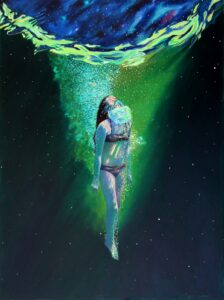
Dreaming Through Snell’s Window
$3,800
Oil on oil paper, 32″ X 24.25″
Exhibition: Patron’s Choice: 2026
Hoagland: Thank you for agreeing to sit down with me. We are really excited to offer the Fine Arts Work Center residency again this year, but we wanted to hear more about your personal experience there. How has it been?
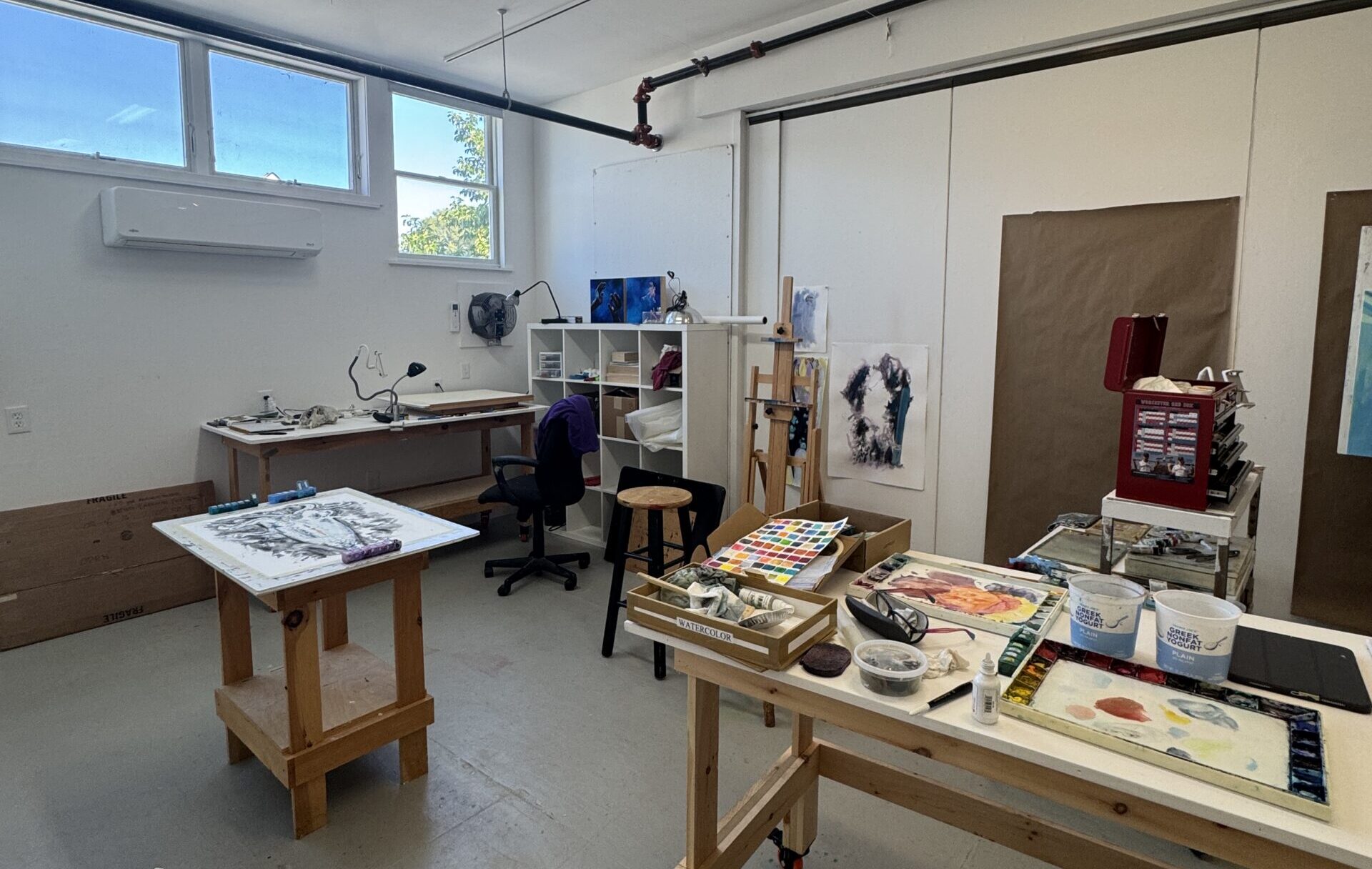
O’Connor: Of course. This was my second time getting the fellowship for the residency and it’s lifechanging. To have a month to work in that type of an environment with the studio and the apartment, everything else gets shut out. I’m not teaching, I’m not doing my taxes, I’m not doing all of the things that you have to catch up with in your day-to-day life.. in addition to having time and space, you’re surrounded by people who also have studios and they’re doing work that they haven’t been able to do.
I think it’s important to take part in that community. Provincetown has openings every Friday night and the gallery switches their shows every week so as an artist, you get to go and meet other artists. You see all that incredible work, and it’s just it’s an amazing invigorating community and experience.
Hoagland: Right, of course,
O’Connor: Personally, walking on the beach every morning was a huge opportunity because water is what I do, I mean that’s my focus. To have the beach to yourself, the sights and the sounds, they played into something that I’ve been working on for the last few years which has manifested into things that I find. I walk a lot, almost 1,300 miles a year, mostly in Worcester but this year at the Fine Arts Work Center I encountered other things.
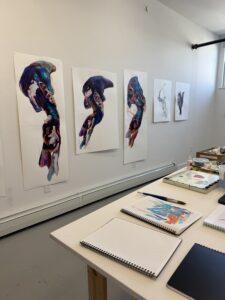
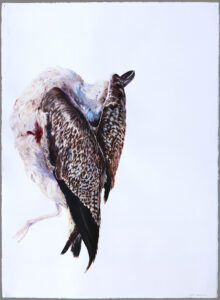
One morning I found a seal dead on the beach and that was gruesome and sad, but I was able to paint it and draw it for three weeks. I found it at the end of the first week and it didn’t go anywhere, so I was able to draw it and to watch the anatomy change.
Hoagland: So, would you go out every morning or so and see how it changed?
O’Connor: Yes, and I filled two sketchbooks with drawings. Every day watching that change and that progression as it decayed. I’m sort of fascinated by skeletal structure and anatomy and I’m always amazed by how similar we are to other species. I see similar elements when I look at the structure of the bones, the rib cage, the spine, the pelvis, all those elements are there even if it’s a bird or a seal; they change depending on what that creature does and how they live but it’s consistent. I’m fascinated by that because I think we tend to separate into ‘us and them’. When people see something lying dead on the beach, they tend to avoid it, they walk or look away from it and I think we have to acknowledge it.
I don’t know if human interaction killed [the seal] or if it was bitten by a shark … but that’s not really the point. The point is seeing the similarities and learning to take care of those creatures … becoming aware of how they exist and how they survive and how we affect them.
As an artist you follow your inspiration and you figure out what it is that [makes you want to] explore and discover. I’m not a big believer in doing the same thing forever and ever, I don’t think that’s creative. I think that’s where people get stuck and fall into something that people like. [That can be] great but also difficult because it can set you away from that creativity and motivation.
If I was going to do the same thing over and over, I would be a doctor. Financially much more secure *laughs*.
Hoagland: *Laughs*, so it sounds like this [residency] really pushed you and your creativity.
O’Connor: Absolutely, I found all of these incredibly beautiful objects … like large lobster claws, I became fascinated by the idea that [the lobster] was something that had entered the human food chain and then somehow had been pulled out of it again. It was an important part of the residency. Not just doing the work but for me, it’s about gathering that inspiration. I will easily get a year’s worth of work from that one month of exploring and discovering.
Hoagland: It sounds like it wasn’t just an uninterrupted space, like you were talking about earlier, but it was also a trade of ideas with the artists that were around you and in your environment.
O’Connor: Yes absolutely. I think my proposal when I applied for the residency was to experiment with watercolor on oil paper as an under painting. The thing about that is you need a flat space for [the paintings] to dry. For example, I use a lot of water because I want my watercolor to break into different textural patterns, that means they can take 16 to 20 hours or longer to dry, which is unusual for watercolor, but it has to be flat and undisturbed for that time. [In my studio] there are no flat surfaces so it’s important for that process to let them be undisturbed and the Fine Arts Work Center has all these resources.
Hoagland: That’s really great. For my next question, you talked about this a little bit, but if you have anything else to share in what ways did the residency inspire you when it came to coming up with the subject matter for Complicated Beauty in your work.
O’Connor: I think it was more of an ‘aha moment’. My exhibition, Complicated Beauty, was so close to the residency that the theme of the work had been going on for a while. I think seeing the seal was what made me really focus on the idea that they’re not that different from us.
We have this idea that there’s ‘us and them’ and I think that makes us feel comfortable eating them or [using] their skin. Oddly, to actually see the seal, I could see where the myth of the mermaid came from. At a certain angle of drawing or standing next to it, it very much looked like a woman, you know the wider hips and the shoulders. It was a moment of understanding what that anatomy is and what happens with it.
Like I said before, it was pretty gruesome for a while, the carcass had lots of maggots, and I don’t paint maggots *laughs*. I was just trying to pull the magic out of it and try as much to honor that creature instead of ignoring it. I think it teaches us how to respect life and our lives…
Hoagland: I’m originally from North Carolina and right before I left to go to grad school I saw an exhibition at the Turchin Center for the Visual Arts that was titled Memento Mori. I mention it because it was also about death and this idea that it’s inevitable. It was a bunch of carcasses, but it was photography, so it was gruesome in that idea of looking at [the animals] but it reminded me of your work because you paint it in a way that’s, at least for me, easier to digest. Death is a difficult topic to discuss and bring together visually but it’s still that same idea of making it familiar if that makes sense.
O’Connor: Yes, yeah. I’d love to see more artists work like this. There are some interesting artists who explore this idea.
Hoagland: You talked about networking events every Friday at the residency where you got to talk with other artists. When I go to exhibition openings, I always get an itch to suddenly create. I’ll get an idea for a series or a body of work and now I just must sit down and do it.
The residency really sounds like a great opportunity where there’s no distractions and you’re really able to execute those ideas right?
O’Connor: Yeah and you’re with like-minded people so it’s so cool. One Friday, I intended for [the event] to be casual but there was a poet in residence while I was there, Janet MacFadyen. She is also a talented flautist, so in response to my seal paintings, she played her flute. It was just really wonderful because she was talking about how she gets inspired for her poetry. [Creativity] is not something you can plan for.
I am very much an introvert so [settings like that] are not easy for me, but to be able to be right next door to someone who has a studio and they say ‘hey, can I come see your work?’, it’s so much easier you just can’t expect it but you can take advantage of it.
Hoagland: Definitely, that sounds fantastic.
O’Connor: And then there’s the apartment! I had an apartment that Nina and Paige came to see. It’s in the building that Robert Motherwell and Helen Frankenthaler painted in. I felt like the ghosts of the past were there and I could really sort of take the energy from that. I know not everybody understands that but I guess, you know, if you’re a writer and you stay in a place that a famous writer stayed, it’s inspiring
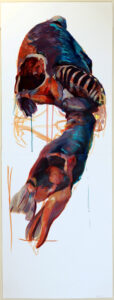
There is Beauty in Accepting Change
Kat O’Connor 2025
Watercolor and Acrylic on Paper
59 1/2″ X 22 1/4″
Hoagland: Oh, I can understand that. My next question is about some of your past statements and interviews. You mentioned that ‘water creates a new environment for the subject and the viewer to experience’. You’ve discussed this but how does this idea still resonate in your work?
O’Connor: Yeah that’s a really interesting question and I didn’t even think about this until you said it. All of the paintings and figures that I’ve done at the Fine Arts Work Center, the backgrounds are white and they’re intended to stay white; they’re not going to have a background. I really wanted to do this and have my [under]drawing remain as much as possible … Usually when I paint it, the drawing disappears. I really wanted to show the artist’s process, so I actually drew them in orange watercolor, and then I started adding very liquid transparent acrylic on top of that. There are only certain areas of the paintings that look more opaque. I like that idea sort of, I don’t know if I want to say the ruggedness, I was wanting my mistakes to show.
Hoagland: Almost more organic?
O’Connor: Yes, exactly, I was wanting the organic directions and the structure of the drawing to show. The backgrounds [of my paintings] are becoming more about the process in the last few years. Regarding my swimmers, they’ve been going off into the universe and it’s not something that I set out to do. It’s not what I had intended but I’m feeling connected to the women. I think women in our society are not as appreciated as they should be, especially older women, and a lot of my models are in their 80s. I think about them… some were doctors or mothers… They were breaking barriers because of their age. When they were going to school, they weren’t supposed to go to school to be a doctor, they were just supposed to be a mother, and then now people just seem to disregard them. I wanted to show that these women are incredible, they’re goddesses and they’re the women that live next door to you. I really wanted to push the idea of these women being larger than life.
It’s interesting that you say that because it has been really specific to me that I wanted the backgrounds to be white yeah and that’s continuing to happen and I I think that’s what it is as I want to show the structure and that the drawings are the paintings are about structure so that remaining is important
Hoagland: I’m glad I asked that because I noticed that big shift and I was wondering why. That answer kind of made me emotional because it reminded me of my mom. She’s still working but she talks about how she’s one of the oldest members of her team in the office and she often feels so invisible. She’s not the same age as your models but she still feels that invisible-ness, how she’s only there for really one purpose even though she’s more than that – she is an artist herself and a mother.
O’Connor: It’s tough, I think unfortunately we marginalize a lot of people, and I think as an artist you have to find what you want to say and what you want people to hear. You can’t really control what people hear but you can kind of draw attention to [these topics] and try to get them to think in a different way. My work certainly isn’t outwardly political, but I think [art] has to follow your beliefs, to convey what you think.

Hoagland: One of my last questions is what type of work do you see yourself making in the coming years and did this residency give you ideas for future work?
O’Connor: Yeah definitely, I really want to further explore why these [natural materials] fascinate me and how portraying them in that way [can feel] more appropriate. It’s very much a thinking thing and I think paintings tell the artist a lot about what they’re thinking. I’m sure you have had the experience where you look at a piece that you did a couple of years ago then you go ‘Oh my God that’s what I was thinking about?!’ and you didn’t know it at the time, but you realized it later on. I think that happens with other people as well so I’m still painting the seals and I don’t think that’s going to stop for a very long time, but why does it resonate with me? I think that’s what’s on my mind a lot now.
There was a lecture that I saw at the Fine Arts Work Center which I was just blown away by. Nicole Eisenman and Helen Molesworth discussed how a lot of artists are very concerned about the political situation and about our responsibility as artists to do something; to make our work useful. She [pointed out that] you can either make work that deals with the situation at hand directly, or you can make beauty to help people deal with it. I thought that was perfect. I’m sorry, I totally got off track!
Hoagland: *Laughs* I mean my last question was for the coming years, so I think that’s a great thought to end on, you don’t know what that idea is going to fruition as.
O’Connor: Right, it’s going to turn into something, it may be years before I know what that is.
Hoagland: My final question is do you have any final thoughts you’d like to share any advice or the person would be getting the residency?
O’Connor: I think just really really be open to possibilities. Don’t go in thinking ‘this is what I do’ or ‘this is me, I’m not changing’. Use this as the impetus for growing. It’s an incredibly valuable experience.
Hoagland: Great advice. Thank you so much for talking with me, it was so nice to meet you.
O’Connor: It was nice to meet you too, thank you.
If you have any questions about the residency or are interested in applying to become an artist member, please visit our membership page or email us at info@copleysociety.org.